Loading…
Loading…
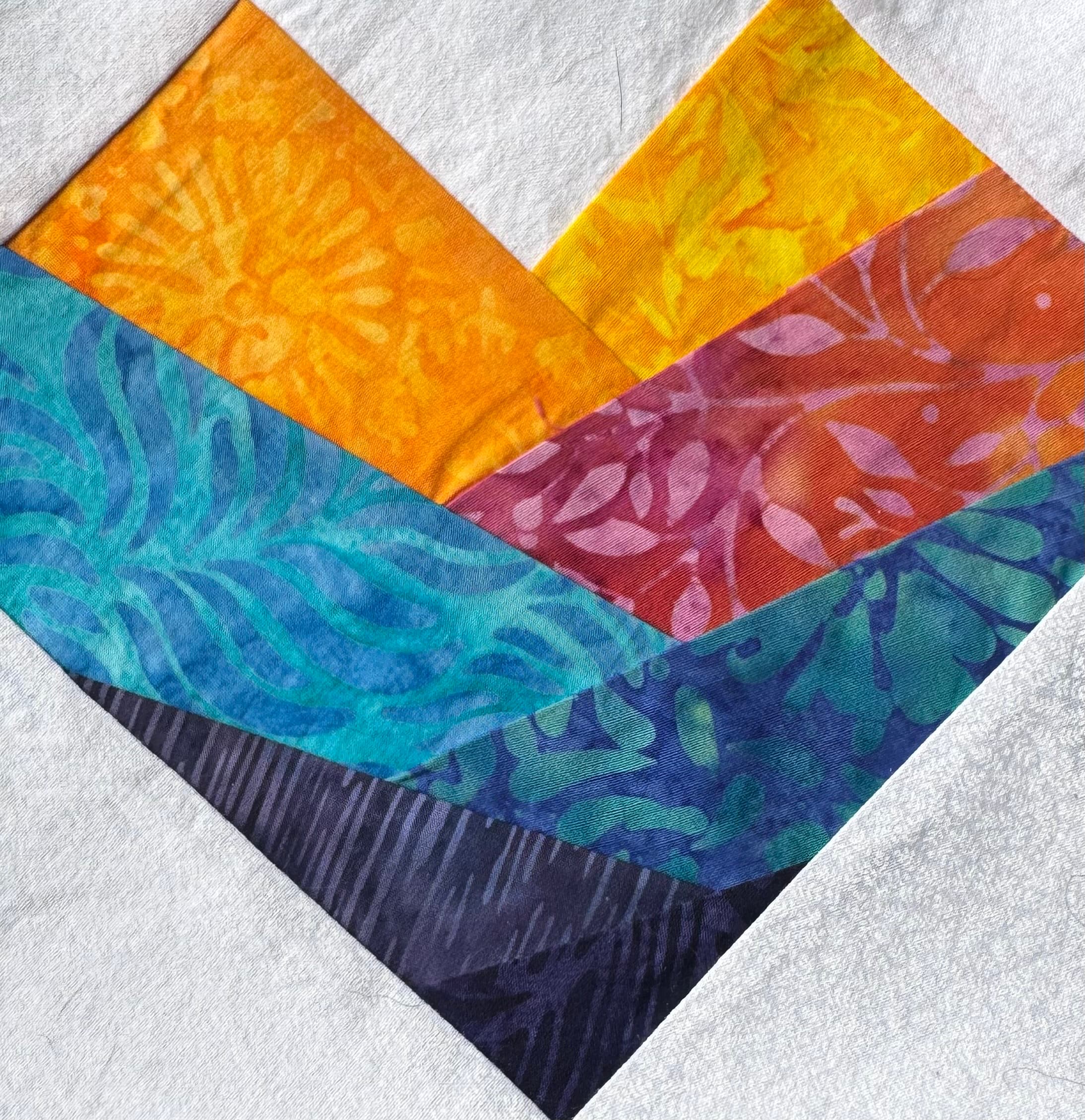
A simple four-patch with a stitch-and-flip corner that turns two plain squares into a floating bow tie
Also known as: Necktie · Well Sweep
The Bow Tie block is a four-patch with a twist: one half-square-triangle pair makes both "tie" triangles, two plain background squares fill the rest, and a small appliquéd knot square hides the center intersection. Set side by side, the ties appear to float on the background — especially striking as a scrappy quilt where every bow tie is a different fabric.
| Fabric | Cut | For |
|---|---|---|
| Ties | 1 square at 6⅞″ | tie squarespairs make 2 HSTs each — trim units to 6½″ |
| Background | 1 square at 6⅞″ | tie squarespairs make 2 HSTs each — trim units to 6½″ |
| Background | 2 squares at 6½″ | background squares |
| Knot | 1 square at 2½″ | center knotappliquéd over the center intersection |
One HST pair (tie fabric + background, right sides together, diagonal seam, cut, trim) makes both tie triangles. Two plain background squares fill the rest of the four-patch; a small knot square is appliquéd over the center where all four corners meet.
The Bow Tie is one of the many American pieced patterns built entirely from half-square triangles and plain squares, which made it inexpensive to produce from scrap fabric and popular with quilters working from limited yardage. It appears in pattern collections under several names — Necktie in some regional traditions, and Well Sweep in others, a nod to the well-sweep water-drawing tool whose silhouette some quilters saw in the block's narrow center.
Like many four-patch patterns, Bow Tie was especially well suited to scrap quilts: because each block uses only a small amount of the "tie" fabric, quilters could work through a scrap bag one bow tie at a time, with the background fabric staying consistent to unify the whole top. The optional appliquéd knot at the center — a tiny contrasting square turned under and stitched over the intersection — is the detail that gives the pattern its name and its charm, though many quilters skip it and let the pieced center speak for itself.
The block remains a favorite for controlled-scrappy quilts today: a single, consistent background fabric with dozens of different "tie" fabrics reads as intentional rather than chaotic, and the block sews up quickly since it's built from just one HST pair and two plain squares.
For a 12" finished block: one 6⅞" square each of tie fabric and background (for the HST pair), two 6½" background squares, and one 2⅝" square of knot fabric (optional).
Place the tie-fabric square and one background square right sides together. Draw a diagonal line on the back of the lighter square, sew a scant ¼" on each side of the line, cut on the line, press toward the darker fabric, and trim both resulting squares to size — this single pair yields both tie triangles you need.
Arrange the two HST units in opposite corners with their tie-colored triangles pointing toward the center, and the two plain background squares in the remaining corners.
Sew the top row, then the bottom row, pressing seams in opposite directions so they nest. Join the rows, matching the center seam carefully — this is where the bow tie's "knot" reads clearly.
Turn under the edges of the small knot square and appliqué it over the center intersection by hand or machine. At smaller block sizes the knot can be too tiny to turn cleanly — the block still reads well without it.
Two fabrics are the minimum: a consistent background and a tie fabric. For a scrappy quilt, keep the background fixed and let the tie fabric vary block to block — low-volume prints or a mix of solids both work well. The optional knot square is a great place for a single accent color repeated across every block, which quietly ties a scrappy quilt together.
Ready to pull fabric for this one? These are the retailers we trust.
We may earn a commission on purchases made through these links, at no extra cost to you. Learn more.
One consistent background fabric with a different tie fabric in every block — the classic scrap-quilt treatment for this pattern.
Same block, regional name — occasionally shown with the ties set on a diagonal grid rather than straight.
A related four-HST block, but all four triangles point the same rotational direction instead of two opposing pairs.
NiftyFifty quilters have been swapping blocks like this one since 1997. Browse our historical archive or join a new swap.
Browse quilt swaps →The most versatile unit in patchwork — master this and you can make hundreds of different quilt patterns
Four half-square triangles arranged to spin — one of the most dynamic and beginner-friendly patterns
The first block most quilters learn — simple, fast, and the foundation of dozens of classic patterns
Real quilters, real deadlines. Here's what's open to join.