Loading…
Loading…
A classic directional unit with countless uses — from single-row borders to full chevron quilts
Also known as: Wild Goose Chase
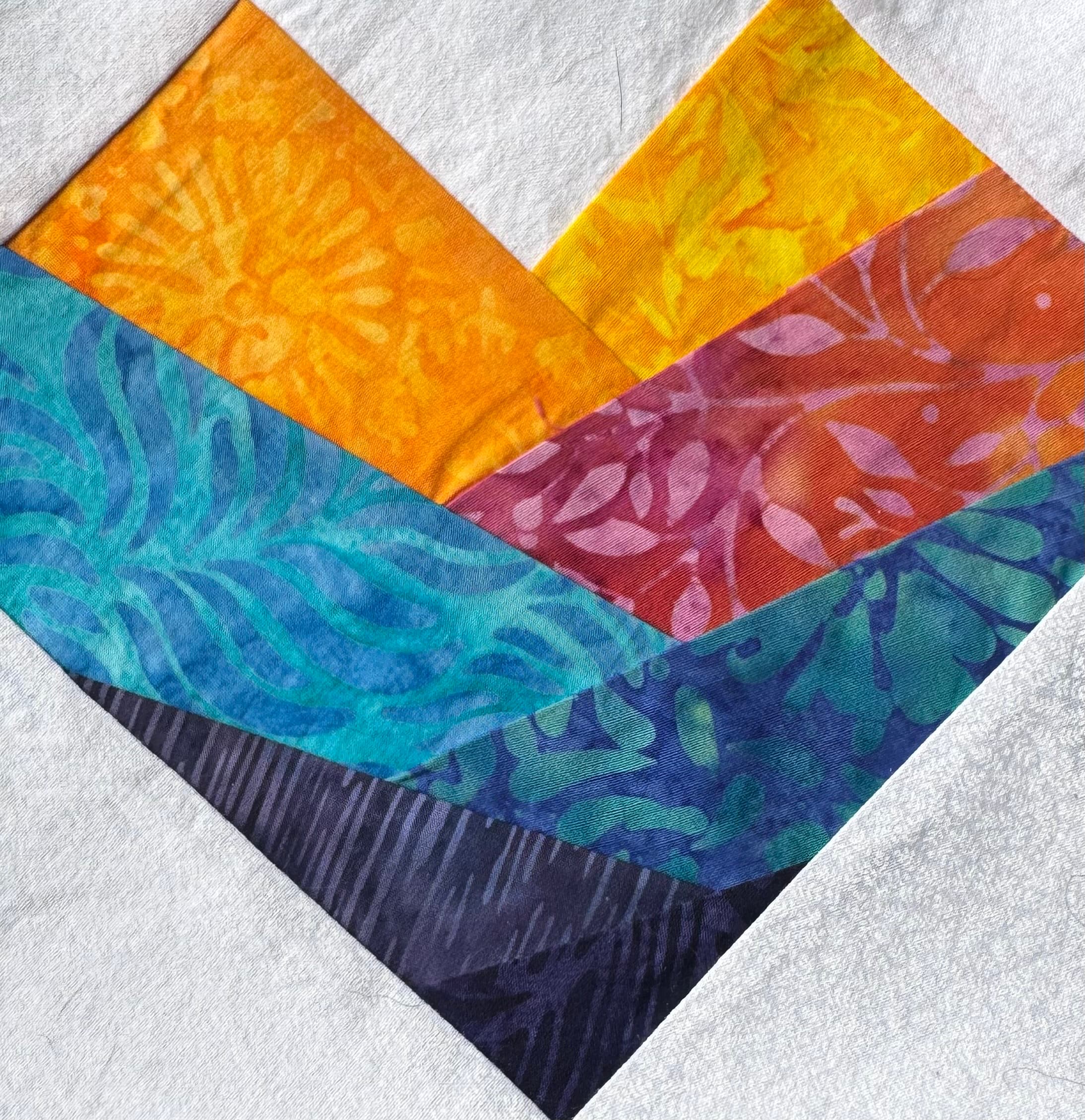
Flying Geese is one of American quilting's most enduring images — a triangle pointing forward with two smaller triangles forming the sky on each side. Used as a standalone block, a border unit, or assembled into chevrons and arrows, it's both simple to understand and almost infinitely versatile.
| Fabric | Cut | For |
|---|---|---|
| Goose (the triangle) | 1 rectangle at 4½″ × 2½″ | goose rectangle |
| Sky (background) | 2 squares at 2½″ | sky squaresone per end, sewn on the diagonal |
Stitch-and-flip: sky square on one end of the goose rectangle, sew the diagonal, trim and flip; repeat on the other end. Makes one goose finishing B × B/2.
The Flying Geese block draws on the most literal of American landscape images: formations of migrating Canada geese moving across a wide sky. Quilters in the 19th century looked up at those diagonal V-formations and saw a perfect patchwork pattern — one large triangle pointing the direction of travel, flanked by two smaller sky triangles.
Early Flying Geese quilts from the 1840s and 1850s were often made from two fabrics only: a dark print for the geese and a light muslin for the background. Set in long vertical or diagonal rows, they created the illusion of motion across a quilt that no static pattern could match. Abolitionist quilters are sometimes said to have used Flying Geese patterns as signals on the Underground Railroad — pointing the way north — though historians debate how widespread this practice actually was.
The modern "no-waste" Flying Geese method, which produces four identical units from five squares without waste triangles, transformed the block's practicality. Today it's one of the fastest blocks to produce in bulk, making it a staple for border work, sashing, and background texture.
A Flying Geese unit is always twice as wide as it is tall. A 2"×4" finished unit requires one 4½" × 2½" rectangle (the goose) and two 2½" squares (the sky). Or use the no-waste 4-at-a-time method: one 5¼" square (goose) + four 2⅞" squares (sky) = four 2"×4" finished units. The formula: goose square = finished width + 1¼"; sky squares = finished height + ⅞".
Draw a diagonal line on the wrong side of each small sky square. Accuracy here matters — even a slightly off-diagonal creates a lopsided point.
Place one marked sky square on the right end of the large rectangle, right-sides-together. The diagonal line should go from the top-right corner to the bottom-left of the overlay square. Sew on the drawn line. Trim seam allowance to ¼". Press open.
Repeat on the left end of the rectangle. The two diagonal seams should form a V pointing toward the goose triangle. Trim and press.
The peak of the goose triangle should be ¼" from the top raw edge — exactly one seam allowance away. If it's buried in the seam, your unit will lose its point when sewn into the quilt. Adjust by sewing slightly outside the drawn line.
Four geese in a row make a border unit. Four geese pointing toward a center make a Pinwheel Star. Eight pointing outward make a traditional Flying Geese medallion center. Arrange as chevrons for a modern quilt top.
Strong contrast between goose and sky is essential — if they're close in value, the triangle disappears into the background. The goose fabric can be scrappy (a different print in every block) while the sky stays consistent, which is the classic 19th-century approach. For modern quilts, consider a gradient of goose fabrics from light to dark across a row of geese.
Ready to pull fabric for this one? These are the retailers we trust.
We may earn a commission on purchases made through these links, at no extra cost to you. Learn more.
Rows of geese pointing alternately left and right create a V-pattern across the quilt.
Four geese pointing inward toward a center square, forming a spinning star shape.
A traditional block combining Flying Geese units with nine-patch grid.
A larger goose unit containing a smaller goose inside, creating nested triangle layers.
NiftyFifty quilters have been swapping blocks like this one since 1997. Browse our historical archive or join a new swap.
Browse quilt swaps →The most versatile unit in patchwork — master this and you can make hundreds of different quilt patterns
Four half-square triangles arranged to spin — one of the most dynamic and beginner-friendly patterns
Flying geese arranged in mirror-image V-shapes — one of modern quilting's most popular geometric designs
Real quilters, real deadlines. Here's what's open to join.