Loading…
Loading…
A center square, four background squares, and four corner half-square triangles pointing inward — one of the simplest true star blocks
Also known as: Hole in the Barn Door · Churn Dash Variation · Puss in the Corner
Shoo Fly is a nine-patch built from just two techniques: half-square triangles and plain squares. Four corner HSTs, oriented so the accent triangle points toward the center, frame a solid center square with plain background squares on the four sides. It's often the first "star-look" block new quilters make after mastering the half-square triangle.
| Fabric | Cut | For |
|---|---|---|
| Center & corners | 1 square at 4½″ | center square |
| Center & corners | 2 squares at 4⅞″ | corner squarespairs make 2 HSTs each — trim units to 4½″ |
| Background | 2 squares at 4⅞″ | corner squarespairs make 2 HSTs each — trim units to 4½″ |
| Background | 4 squares at 4½″ | edge squares |
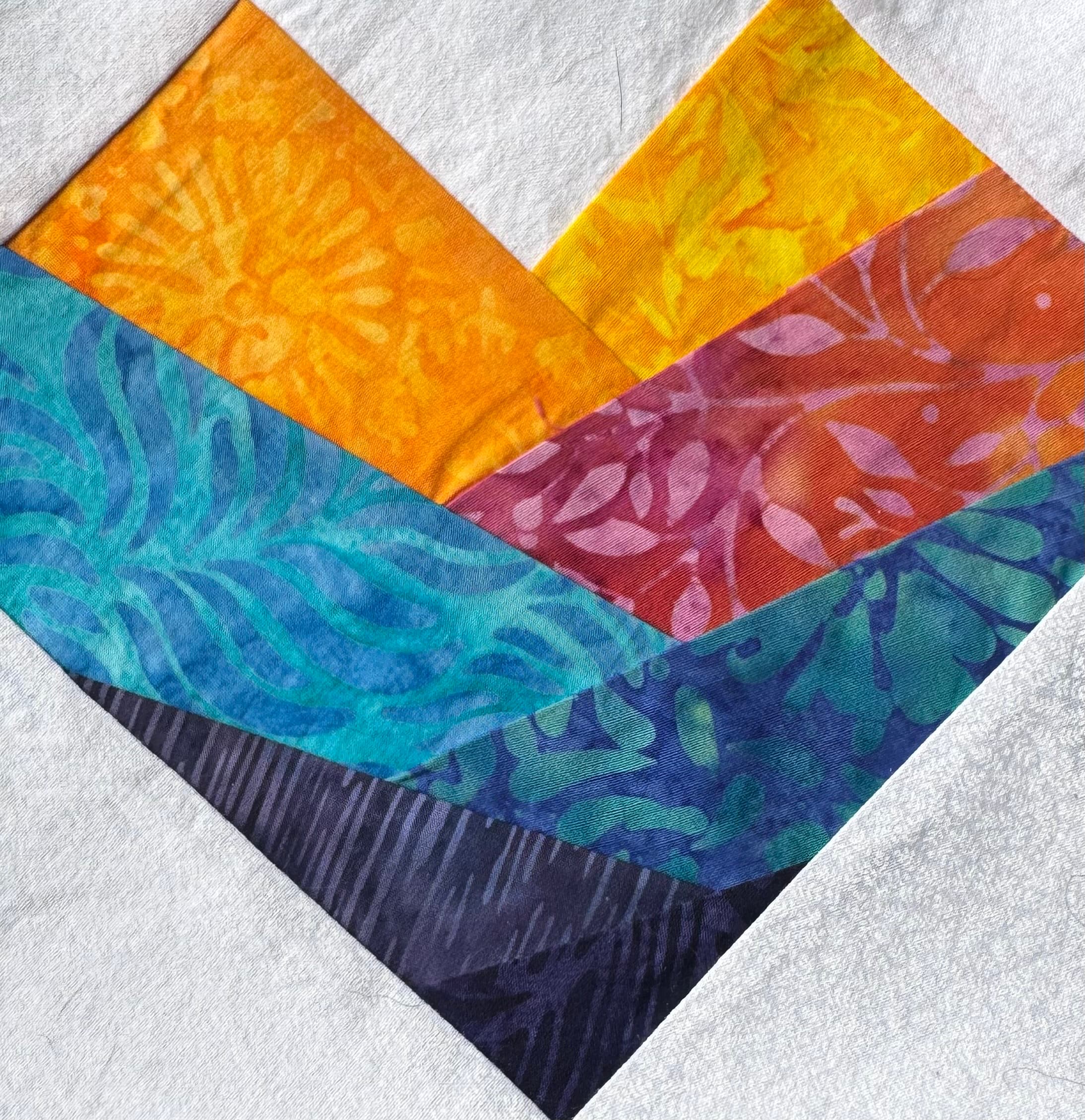
Four corner HSTs (one fabric pair makes all four — two pairs total) with the accent triangle pointing toward the center, four plain background squares on the sides, and a solid center square in the same fabric as the corners.
Shoo Fly is one of the most widely published beginner blocks in American quilting, popular in part because it teaches half-square-triangle construction while producing a result that reads as far more sophisticated than the two techniques involved. It shares its "Hole in the Barn Door" name with several other simple nine-patch variations, a reminder that quilt-block names were rarely standardized nationally — a pattern known as Shoo Fly in one community might be called something else a hundred miles away.
The block sits in the same family as Churn Dash and Ohio Star — all three are nine-patch arrangements built around a center square, but each uses a different piecing unit at the edges and corners. Shoo Fly uses the simplest of the three: plain half-square triangles rather than Churn Dash's rectangle-and-HST combination or Ohio Star's quarter-square triangles. That simplicity made it a natural choice for scrap quilts, sampler quilts, and any project where a quilter wanted graphic punch without a steep technique curve.
Because it's built entirely from one repeated unit (the HST) plus plain squares, Shoo Fly strip-piece and chain-piece beautifully, and it remains a standard teaching block in beginner quilting classes today.
For a 12" finished block: one 4½" center square, four 4½" background squares, and two 4⅞" squares each of accent and background fabric for the corner HSTs.
Pair the 4⅞" accent and background squares right sides together, two pairs total. Draw a diagonal line, sew a scant ¼" on each side, cut on the line, press toward the accent fabric, and trim each of the four resulting squares to 4½".
Lay out the block: center square in the middle, one HST in each corner with the accent triangle pointing toward the center, and one plain background square on each of the four sides.
Sew the three rows of three, pressing seams in opposite directions row to row so they nest. Join the rows, matching the center intersections carefully.
Two fabrics are all you need: a background and an accent for the center square and corner triangles. High contrast between the two makes the inward-pointing star shape read clearly. For a scrap quilt, keep the background consistent and let the accent fabric vary from block to block.
Ready to pull fabric for this one? These are the retailers we trust.
We may earn a commission on purchases made through these links, at no extra cost to you. Learn more.
The corner HSTs stay, but the edge squares become dark/light rectangle pairs — a slightly more complex cousin.
Corner HSTs are replaced by quarter-square-triangle star points for a full 8-pointed star effect.
Regional name for a very similar nine-patch-with-corner-triangles construction.
NiftyFifty quilters have been swapping blocks like this one since 1997. Browse our historical archive or join a new swap.
Browse quilt swaps →A center square, four half-square triangles, and four rectangles — a classic mid-19th century design with bold graphic impact
Eight crisp star points emerge from four quarter-square triangle units — a pattern that rewards precise piecing
The most versatile unit in patchwork — master this and you can make hundreds of different quilt patterns
Real quilters, real deadlines. Here's what's open to join.