Loading…
Loading…
Flying geese arranged in mirror-image V-shapes — one of modern quilting's most popular geometric designs
Also known as: Zigzag · Streak of Lightning
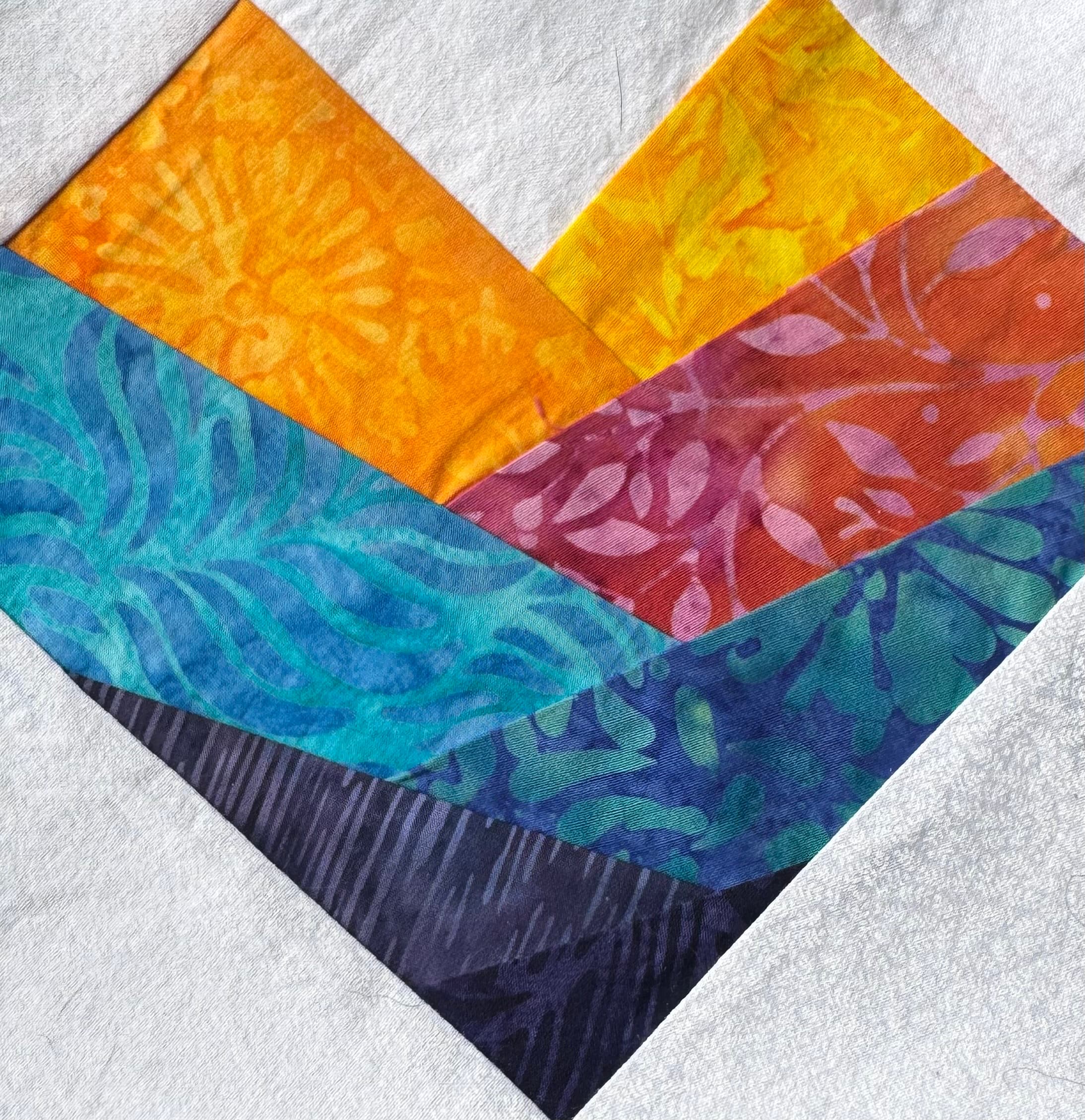
The Chevron is modern quilting's signature pattern — flying geese units mirrored and aligned in rows create bold V-shaped stripes that seem to march across the quilt surface. Simple enough to explain in a sentence, beautiful enough to hang on a gallery wall.
| Fabric | Cut | For |
|---|---|---|
| Geese (the V) | 2 rectangles at 4½″ × 2½″ | goose rectangles (one per side of the V) |
| Sky | 4 squares at 2½″ | sky squarestwo per goose, stitch-and-flip |
Each V is two flying geese in mirror image. Make geese in bulk with stitch-and-flip, keeping lefts and rights in separate stacks.
The chevron or herringbone pattern has roots in ancient textiles — it appears in weaving traditions from ancient Egypt, Greece, and Rome, in the parquet floors of European palaces, and in the tweed fabrics of British tailoring. In quilting, the chevron pattern gained major popularity in the early 2010s, when the modern quilting movement elevated it to one of the defining patterns of the era.
The quilt chevron is typically made from flying geese units arranged in rows — one row pointing left, the next pointing right, creating the classic V-shape. This construction means any technique for making accurate flying geese translates directly to chevron quilts, and the no-waste 4-at-a-time flying geese method makes chevron quilts surprisingly fast to produce.
Designers like Anna Maria Horner and the collective that popularized the "Herringbone" pattern in quilting publications around 2011 brought the chevron from crafting background to quilting foreground. It remains one of the most searched quilt patterns and one of the most produced designs by modern quilters.
Chevrons are made from flying geese units. A common size for a throw quilt: 3"×6" finished flying geese units (3½"×6½" unfinished). Plan your layout — how many geese per V, how many V-rows across, how many rows tall.
Use the no-waste 4-at-a-time method to make large quantities of flying geese efficiently. Sort fabrics into left-pointing and right-pointing piles if you're using directional fabrics.
For each V in the chevron, you need one flying-geese strip pointing right and one pointing left. Left-pointing and right-pointing units are mirror images. To make a left-pointing unit, mark the diagonal on your sky squares going the opposite direction (from bottom-right to top-left instead of top-left to bottom-right) — the rectangle itself stays the same. Rotating the rectangle 180° does nothing since a rectangle is symmetric; only the diagonal direction on the sky squares creates the mirror.
Sew geese into horizontal rows: one row pointing right, one row pointing left, alternating. Sew rows together, matching the points of the V precisely. The V-shape emerges where the opposing rows meet.
The chevron pattern is most powerful when the goose fabric contrasts strongly with the sky/background. Single-color chevrons on a white background create a bold, modern statement. Ombré chevrons — fabrics graduating from one color to another — create a gradient effect across the quilt. Scrappy chevrons with many goose fabrics unified by one consistent background are also very popular.
Ready to pull fabric for this one? These are the retailers we trust.
We may earn a commission on purchases made through these links, at no extra cost to you. Learn more.
Chevrons with narrow, closely-spaced V-rows for a denser, more textile-like effect.
A single large V pointing in one direction, like an arrow across the quilt.
Alternating single rows of geese rather than paired V-shapes.
NiftyFifty quilters have been swapping blocks like this one since 1997. Browse our historical archive or join a new swap.
Browse quilt swaps →A classic directional unit with countless uses — from single-row borders to full chevron quilts
The most versatile unit in patchwork — master this and you can make hundreds of different quilt patterns
Three strips, one seam allowance, infinite layouts — the fastest quilt you can make
Real quilters, real deadlines. Here's what's open to join.