Loading…
Loading…
The Log Cabin's sibling — strips added to opposite sides create a symmetrical, architectural pattern
Courthouse Steps is the Log Cabin's quieter sibling — strips added to opposite sides simultaneously rather than spiraling around the center. The result is a symmetrical block with a cross or ladder appearance and its own distinctive secondary patterns.
| Fabric | Cut | For |
|---|---|---|
| Center | 1 square at 2½″ | center square |
| Top & bottom steps | 2 rectangles at 4½″ × 1½″ | logs |
| Top & bottom steps | 2 rectangles at 6½″ × 1½″ | logs |
| Top & bottom steps | 2 rectangles at 8½″ × 1½″ | logs |
| Top & bottom steps | 2 rectangles at 10½″ × 1½″ | logs |
| Top & bottom steps | 2 rectangles at 12½″ × 1½″ | logs |
| Side steps | 2 rectangles at 2½″ × 1½″ | logs |
| Side steps | 2 rectangles at 4½″ × 1½″ | logs |
| Side steps | 2 rectangles at 6½″ × 1½″ | logs |
| Side steps | 2 rectangles at 8½″ × 1½″ | logs |
| Side steps | 2 rectangles at 10½″ × 1½″ | logs |
Like Log Cabin, but strips go on in OPPOSITE pairs: two dark sides, then two light top-and-bottom, keeping the block symmetrical.
Courthouse Steps is almost as old as Log Cabin, and the two blocks were often made together in 19th-century quilts. The name suggests the visual image of steps approaching a courthouse door: horizontal strips of increasing length added to the top and bottom of a rectangle, like stair treads rising toward the center.
The block differs from Log Cabin in a fundamental construction way: rather than spiraling clockwise around the center square, strips are added to opposite sides simultaneously — first top and bottom, then left and right, alternating between light and dark fabrics. This creates a cross-shaped light/dark pattern rather than the diagonal half-and-half split of a true Log Cabin.
The secondary patterns created by Courthouse Steps are uniquely geometric — when blocks are assembled, the strips form continuous horizontal, vertical, or diagonal bands across the quilt rather than the diamond-shaped secondary patterns of Log Cabin. Contemporary quilters have embraced Courthouse Steps as a modern alternative to Log Cabin because its strong horizontal/vertical geometry photographs particularly well and suits the clean aesthetic of modern quilting.
Cut a center square — 2" or 2½" finished is typical for a 12" finished block. This is often a red or accent fabric. Sew a light strip to the top and bottom. Press outward.
Sew dark strips to the left and right. Press outward. The center unit should now be a rectangle with light fabric on top/bottom and dark fabric on the sides.
Return to light strips for the second pair — top and bottom again. Then dark strips for left and right. Each round, the strips are longer because the block is growing. Cut strips to length as you add them, or pre-cut a range of lengths.
Always add light to top/bottom and dark to sides (or vice versa) — never mix the pairing in a single round. The light/dark split is what creates the cross pattern in the finished block.
Strong value contrast (true light vs. true dark) is essential. The cross pattern disappears when light and dark fabrics are too similar in value. The center square benefits from a contrasting accent color that doesn't appear elsewhere in the block.
Ready to pull fabric for this one? These are the retailers we trust.
We may earn a commission on purchases made through these links, at no extra cost to you. Learn more.
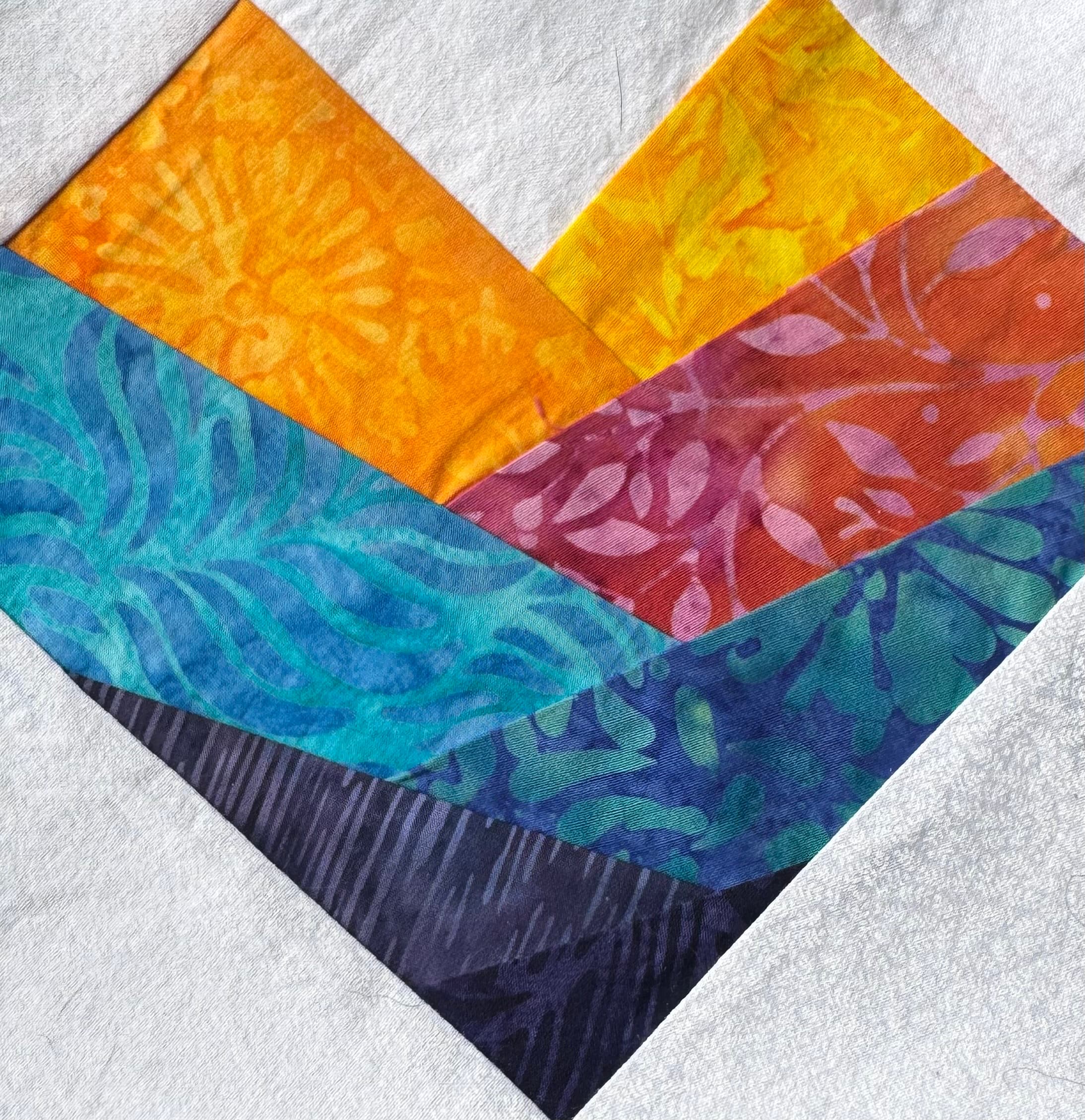
Light strips in a gradient of colors from warm to cool, or in the colors of the rainbow arranged around the block.
Strips of varying widths on each side, breaking the symmetry deliberately for a more improvisational feel.
NiftyFifty quilters have been swapping blocks like this one since 1997. Browse our historical archive or join a new swap.
Browse quilt swaps →America's most iconic quilt block — strips sewn around a center square in an endlessly adaptable design
Three strips, one seam allowance, infinite layouts — the fastest quilt you can make
The first block most quilters learn — simple, fast, and the foundation of dozens of classic patterns
Real quilters, real deadlines. Here's what's open to join.